AI feature validation before you commit to a build
Validate an AI feature by measuring whether it improves a specific user task after checking, correction and recovery are included. Compare implementation approaches against the observed failure, test representative cases and define a useful fallback. Use a limited pilot to decide whether the evidence supports more work.


The short version
- Define the task. Compare with the current workflow through an accepted outcome.
- Match the approach to the failure. The workbook compares prompting, RAG and fine-tuning.
- Test difficult cases. Five case types include missing evidence and access boundaries.
- Record the next decision. Choose Pilot, Revise or Stop with owners and operating limits.
Watch Episode 3: The AI Feature Graveyard
Watch: The AI Feature Graveyard
An AI feature needs to help someone finish a real task. Watch the episode, then use the workbook to compare the current workflow with an AI-assisted version, including the work of checking, correcting and recovering from its output.
Get the companion workbook ↓Start AI feature validation with the user task
AI feature validation starts with a user task, a measurable current workflow and a reason to believe AI can improve it. Observe how people complete the work now, including their checks and recovery steps. Define a useful result before selecting an implementation or committing to a production build.
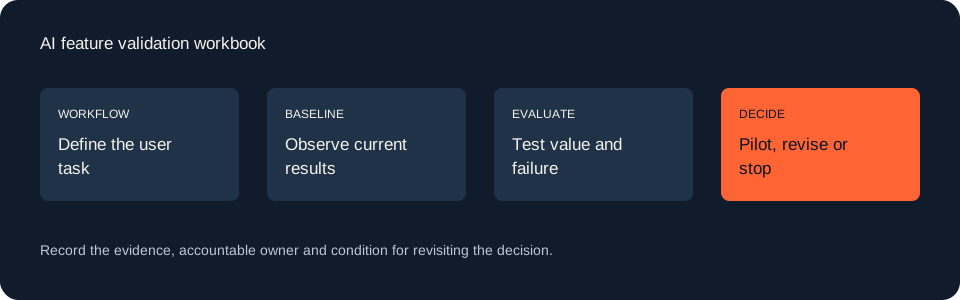
A feature proposal such as an assistant for account managers is too broad to evaluate. Narrow it to a task with an input and an accepted outcome: preparing a response to a customer question using the current account policy, for example. Name who performs the task, what information they may access and who has authority to approve the result.
Google PAIR recommends finding the intersection of user needs and AI strengths. Use that principle to inspect the existing friction. Is the user missing information, struggling to compose an answer or navigating an unclear process? Each diagnosis suggests a different experiment. A conventional interface change may be the appropriate comparison when the process itself is confusing.
Collect task records with permission and redact data as required by the pilot boundary. Include failed attempts and work completed through unofficial workarounds. If you only observe experienced operators, record that limitation before generalizing to new users. Ask what would make the proposed result unacceptable even when it looks plausible.
For teams choosing which AI features customers might use, this task definition should accompany the product brief. It gives engineering a concrete input, output and acceptance question instead of asking a prototype to demonstrate broad intelligence.
Measure the whole workflow before claiming value
Compare the proposed feature with the current way of completing the same task. Include checking, correction, waiting and recovery in the baseline. Record the actual units and observation conditions, then agree which improvement would justify the operating cost and which failure would rule out a pilot.
Measure the work from a defined starting event to an accepted result. Distinguish hands-on effort from elapsed time. If users already have a search tool or template, include it in the baseline. A comparison with an artificially inconvenient manual process will give the wrong build decision.
Record task volume and the people observed, along with missing data and unusual events. Ask the product owner to define a meaningful benefit for this workflow. It might be less correction effort, more complete information or faster completion with an unchanged acceptance standard. Use the units that matter to the task and preserve the assumptions behind the target.
A clearly fictional example: an account support team wants help drafting policy responses. A generated draft appears quickly, but a reviewer still has to locate the governing policy and verify the account context. The experiment must include those checks. If the current template already handles straightforward cases well, evaluate the proposed feature on the harder cases too.
Cost belongs in the same record. Include usage, retrieval infrastructure where relevant, evaluation work, support and ongoing ownership. A feature can pass an output check and still fail the business case when the review burden is counted. Keep estimated future volume separate from observed pilot use.
Compare prompting, retrieval and fine-tuning by failure mode
Compare prompting, retrieval augmented generation and fine-tuning against the observed task failure. Prompting tests instructions and supplied context; retrieval brings relevant external information into the response path; fine-tuning uses examples to adapt task behavior. Evaluate the simplest plausible approach first while preserving a fair test for the alternatives.
AWS describes retrieval augmented generation as using source information to improve generated responses. That makes retrieval a candidate when the task depends on changing or private knowledge. The evaluation still needs to test whether the system finds the correct material, respects access boundaries and uses the evidence appropriately.
AWS describes supervised fine-tuning through labeled examples for specific tasks. Consider it when a persistent behavior or format problem remains after a suitable baseline, and when representative, usable examples exist. Record who labels the data and how you will keep evaluation cases separate. Fine-tuning does not remove the need for current task information.
| Approach | Question to test | Evidence to retain |
|---|---|---|
| Prompting | Can instructions and available context meet acceptance? | Versioned prompts and scored task results |
| RAG | Does relevant source retrieval address the failure? | Retrieved material, permissions and response checks |
| Fine-tuning | Do labeled examples address persistent behavior? | Data provenance and held-out task results |
Record reasons for excluding an approach rather than forcing every team to implement all of them. Where an agentic retrieval design adds tool calls or decisions, include those behaviors in the evaluation boundary. Architecture names alone do not establish usefulness or a reliable delivery timeline.
Use five case types with explicit acceptance conditions
Build a task-specific evaluation covering normal inputs, ambiguous requests, missing evidence, conflicting or stale material and misuse or access boundaries. For every case, define acceptable behavior and the consequence of failure. These five case types organize the workbook; they are an editorial review method rather than an official validation standard.
OpenAI evaluation guidance recommends task-specific tests that reflect real-world distributions. Use observed work to choose representative cases and reserve examples that were not used while editing prompts or training behavior. Document who selected the cases and which groups or task variants the set misses.
Normal cases establish whether the feature can do the intended job. Ambiguous cases test whether it asks a useful question instead of silently choosing an interpretation. Missing-evidence cases test whether it can acknowledge an information gap and offer a usable next step. Set those expectations before looking at outputs.
Conflicting or stale material needs an explicit policy for authority and freshness. Access-boundary and misuse cases test what happens when a request crosses the pilot's permitted behavior. A superficially helpful answer can be unacceptable if it exposes information the user should not receive. Assign the relevant data or security owner to review those cases.
Store the input, expected behavior, observed result, evaluator and reason for the judgment. Report results by case type, including severe failures, instead of hiding them in an overall average. Repeat enough runs to understand observed variation within your review budget, and record that budget as a limit rather than claiming the set proves general reliability.
Design correction and fallback before a pilot
Give users a clear way to verify, correct and abandon an AI result while preserving the task they were trying to complete. Define when the system should ask for clarification, show an information gap or route to a person. Test the fallback with the same care as the successful path.
Google PAIR guidance on graceful failure asks whether users can move forward after an AI failure. Map that question to the task. If a draft lacks sufficient policy evidence, can the user open the relevant source, edit the draft and continue through the existing workflow? Decide what context a human reviewer needs to avoid restarting the task.
Microsoft HAX recommends efficient correction when an AI system is wrong. Include the effort to make a correction in the value comparison. A user who must repeatedly reconstruct their original input may be worse off despite a polished first answer. Test cancellation, editing and recovery with participants who were not involved in building the prototype.
Google PAIR describes feedback as communication between the user, product and team. Give feedback a named owner and a triage route. Record whether a report concerns source content, retrieval, model behavior or the interface. Collecting a rating does not automatically improve a model or establish that the problem has been fixed.
For the transition from proof of concept into production, define escalation capacity and an operational stop condition. A fallback that assumes unlimited reviewer availability is incomplete. State the expected workload, current evidence and person who can reduce or suspend the pilot.
Limit the pilot and capture usable evidence
Run a pilot within a documented boundary of users, tasks, data and actions. Assign operational and product owners, preserve an existing route to complete the task and collect evidence of both benefit and failure. A limited pilot supports a bounded decision; it does not prove the feature is ready for every user or workload.
NIST AI RMF considers trustworthiness across design, development, use and evaluation. Use that lifecycle perspective when describing the pilot boundary. State what the feature may read, what it may produce and which actions require human approval. Record the retention and access rules for the evidence you collect.
Keep a version record for prompts, retrieval settings, source material and model configuration. When a change occurs during the pilot, mark it in the results so improvement is not attributed to the wrong version. Preserve enough detail to reproduce an important failure without retaining unnecessary personal or confidential information.
Ask participants to record accepted outcomes, correction work and situations where they return to the baseline. Include participants who stop using the feature and note the limits of voluntary feedback. A positive comment about a demo is different evidence from completing a real task with acceptable effort and controls.
If you need help implementing the AI application, provide the pilot boundary and evidence questions alongside the feature brief. Require the delivery plan to include evaluation, fallback and ongoing operating responsibility. Additional implementation capacity does not settle whether the feature is useful.
Read pilot results with their limits intact
Interpret results by comparing like tasks against the baseline and checking the predefined acceptance conditions. Separate observed benefit from projections, and examine severe failures even when common cases look good. Identify what the pilot cannot establish before choosing whether to expand it, revise the approach or stop.
Start with the actual tasks completed and the versions used. Report sample coverage, missing records and unusual conditions. If reviewers disagreed about acceptable behavior, resolve that definition before reporting a pass rate. Keep the original judgments available so the decision owner can inspect the disagreement.
Then examine correction and fallback use. A result that users accept after substantial repair may reveal a narrower use case than the original proposal. If the feature helps only when a specialist supplies missing context, record that dependency in the operating model. Do not extrapolate that result to a self-service rollout without another test.
For the fictional policy-response assistant, the team might find retrieval worth investigating because users need current policy passages. That would be a hypothesis supported by the task, not proof that retrieval always beats fine-tuning. The next review would test source selection, conflicting policy versions and the effort to verify a response.
Write the decision sensitivity explicitly: which changed assumption could reverse the business case, and which unresolved failure blocks expansion? That may be source maintenance effort, reviewer availability or a missing user segment. Assign the next evidence task to a person with access to answer it.
Choose Pilot, Revise or Stop with a named owner
Record Pilot, Revise or Stop against the agreed user task, acceptance conditions and evidence limits. Name who owns the decision and the next action. Keep the conditions for expanding, pausing or ending the work visible so enthusiasm for a prototype cannot silently change the pilot's purpose.
Pilot means the bounded experiment is justified and its operating responsibilities are accepted. State the permitted users and actions, the fallback owner and the review condition. Revise means a specific defect or evidence gap must be addressed before another decision. Stop means the task, economics or failure consequences do not support more work under the present assumptions.
The workbook compares three approaches and records five evaluation case types before closing with one pilot decision record. Its prompts require actual values, evidence links and named owners. Those counts describe the resource, not a validated maturity scale or a promise about development speed.
A team considering retrieval implementation support should still retain ownership of source authority, access rules and acceptable behavior. A provider can help build the system and test its mechanics; the product and operating owners must decide whether the resulting workflow is suitable for the people who use it.
Store the decision with its evaluation cases and baseline. Revisit it when the task, user population, source material or operating constraints change. Keep the original limits visible when sharing the result with stakeholders who did not participate in the pilot.
AI feature validation workbook
Define a user task, compare implementation approaches and capture the evidence required for a bounded AI pilot decision.
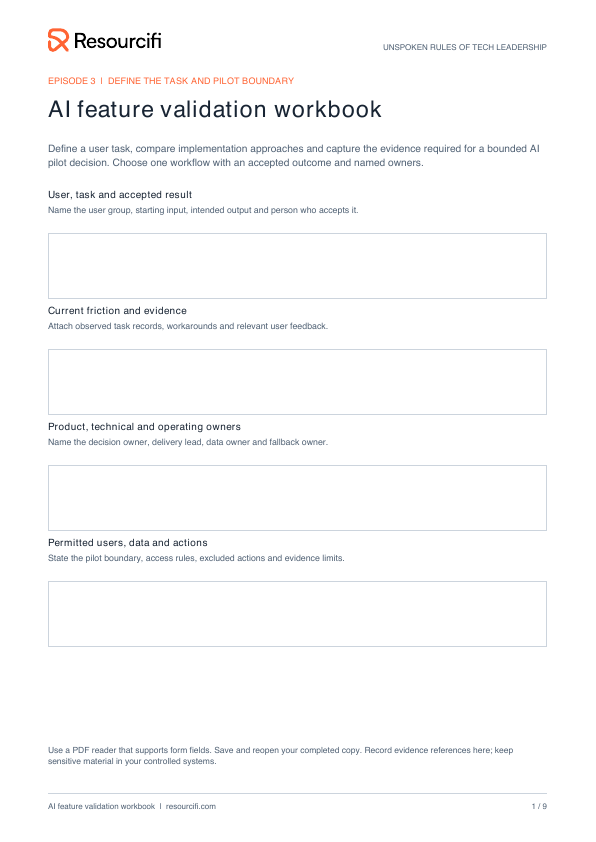
Fillable PDF · 9 pages · Save a copy for each review
Download the workbook
Enter your details for immediate access.
Your workbook is ready.
Open the fillable PDF and save a copy for your review. The delivery status above tells you whether your email was accepted for sending.
Download the workbookThis download link is valid for 7 days.
AI feature validation questions
What does AI feature validation include?
Is RAG always better than fine-tuning?
Which cases should we evaluate?
How should we measure correction burden?
When is a pilot ready to expand?
How do I download the AI workbook?
Sources
- Google PAIR, User Needs + Defining Success. Select AI work from user problems and define success before implementation.
- Google PAIR, Errors + Graceful Failure. Plan for AI errors and give users a useful path forward.
- Google PAIR, Feedback + Control. User feedback and control inform AI quality and the experience.
- Microsoft HAX Toolkit, Support efficient correction. Users need an efficient way to edit or recover from incorrect AI output.
- AWS documentation, Retrieve data and generate AI responses with Amazon Bedrock Knowledge Bases. Retrieval supplies external information to ground generated responses.
- AWS documentation, Customize your model to improve its performance for your use case. Supervised fine-tuning uses labeled examples to improve task-specific behavior.
- OpenAI documentation, Evaluation best practices. Use task-specific evaluations that represent expected real-world distributions.
- NIST, AI Risk Management Framework. Consider trustworthiness across AI design, development, use and evaluation.