Case Studies Book a 30-minute discovery call
Hire AI engineers: a senior AI engineering team shipping LLM systems to production
Hire AI Engineers · Production-First AI™

Hire AI engineers who ship LLM systems to production, not demos.

Hire AI engineers and AI developers who build RAG pipelines, agents and LLM features into your product and keep them running in production, not notebooks that never deploy. You meet and interview the senior engineer before you sign, and placement typically happens in under two weeks because we match from our 200+ in-house experts. Every build is held to a deployment constraint set we agree in writing first, the same Production-First discipline behind our AI work. Per-engineer-per-month pricing is typically about 70% below comparable onshore rates.

 4.9 on Clutch 600+ projects shipped 200+ in-house experts 95% repeat clients
Stanford DOW Snak King Narda Proximity Learning Nextgen Living University of Guelph Lenze iAutomation Emory University IKEA
600+ projects 95% repeat clients 4.9 on Clutch
The discipline

An AI developer accountable to a deployment number.

Hiring an AI engineer is not about prompt cleverness or a demo that works once. You want someone who owns the whole stack: the prompt and context layer, retrieval and agent loops, the evaluation suite that proves the system works, and the monitoring around it, with a named lead and your hours. In the Stack Overflow Developer Survey 2025, 84% of developers already use or plan to use AI tools, yet fewer than half say they trust the accuracy of the output. That trust gap is the whole job: turning capable models into systems you can put in front of users.

Production AI engineering staff augmentation only works when one engineer owns that whole stack. We staff from 200+ employed experts, not a freelancer marketplace, and vet for production AI ability over notebook experience. Before any code, the engineer agrees a deployment constraint set with you in writing: latency, cost per call, throughput, accuracy on a reference dataset, and recovery time. If any number regresses, the build fails.

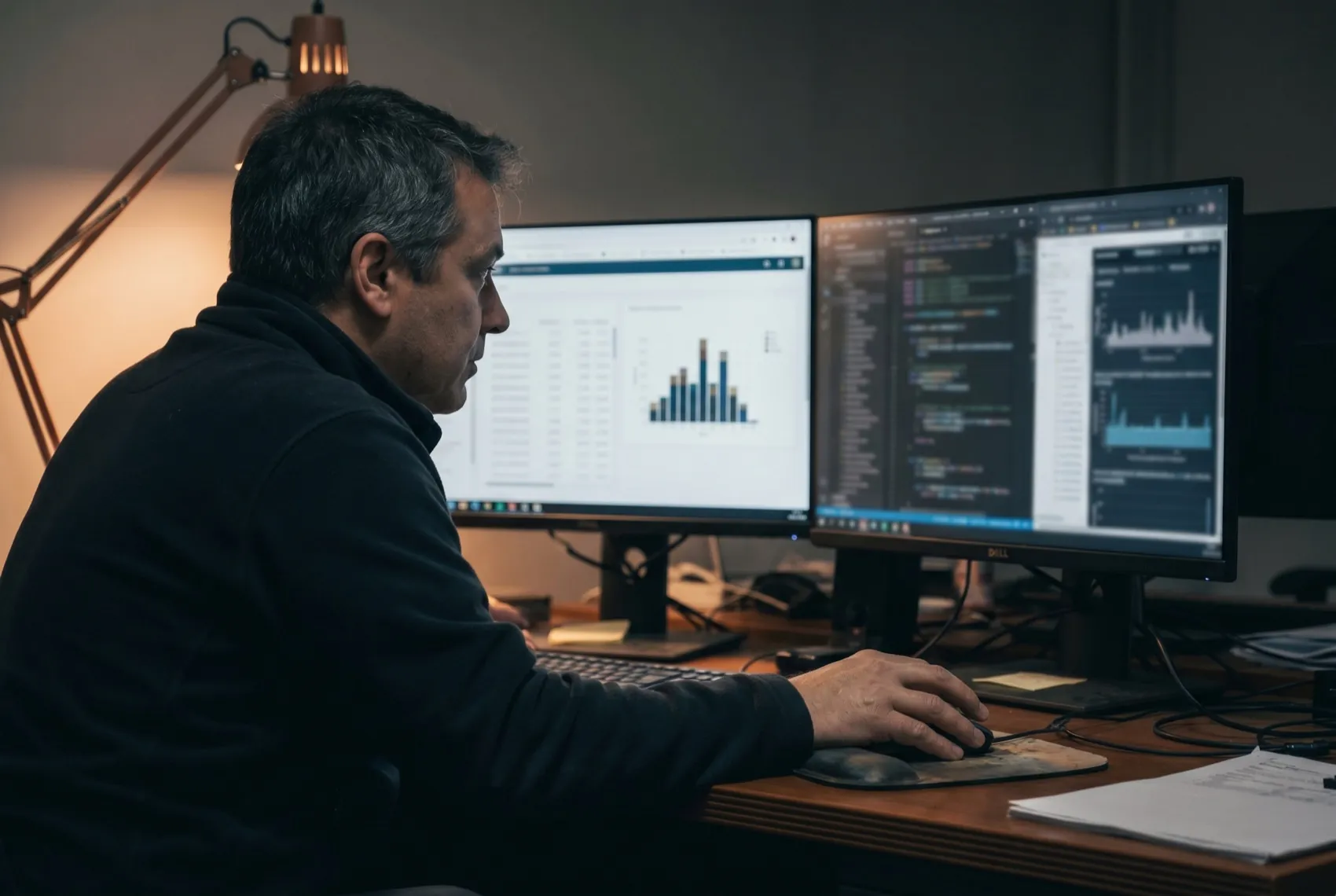
A dedicated AI engineer reviewing an evaluation dashboard for a production LLM system
What an AI engineer owns

Hire AI engineers for the full production loop.

Each engineer owns a layer of the system that puts an LLM in front of real users and keeps it reliable, from retrieval through safe deploy. Move through the stages.

AI engineer designing a retrieval and RAG pipeline at a workstation

Retrieval and RAG pipelines

They design the retrieval layer end to end: chunking, embeddings, vector store choice, hybrid dense plus sparse search, reranking and query understanding, so answers are grounded and stay grounded as your corpus grows.

pgvector · Pinecone · hybrid and rerank
AI engineer building agent loops with tool calling

Agents and tool calling

They build agent loops, ReAct, plan-and-execute, multi-agent and reflexion, with tool use and structured outputs, so the system can take actions against your services rather than just answer.

LangGraph · OpenAI Agents SDK · MCP
AI engineer comparing model outputs for selection and routing

Model selection and routing

They choose and route across hosted frontier models and self-hosted open-weight models, trading off accuracy, latency and cost-per-call, so model choice is a tested decision, not an assumption made at contract.

Claude · GPT · open-weight via vLLM
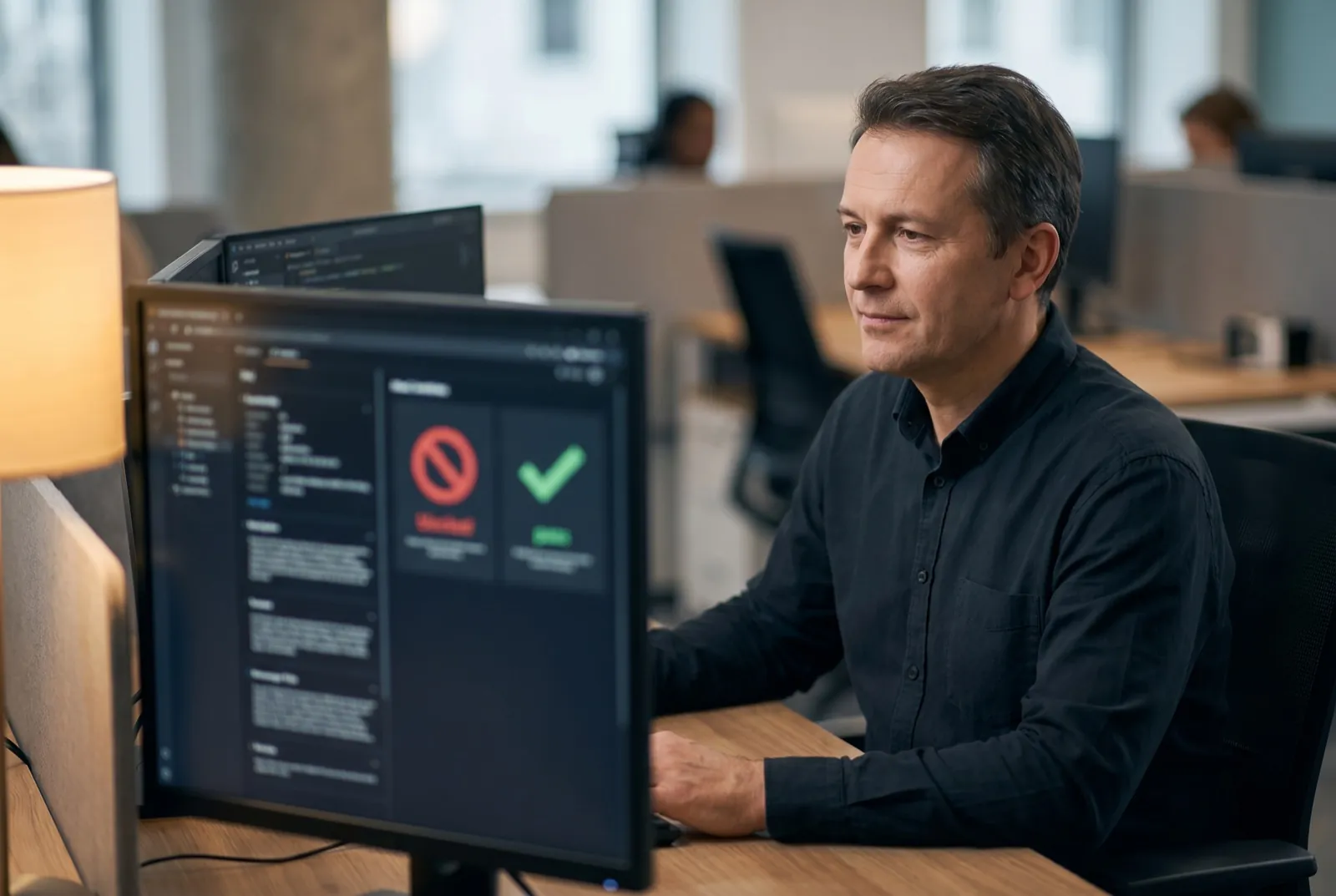
AI engineer reviewing an evaluation harness wired into CI

Evaluation harness

They wire a three-layer eval suite into CI: reference tests for known-good behaviour, adversarial tests for edge cases and prompt attacks, and regression tests seeded from production incidents, so a build fails when quality drops.

LangSmith · Braintrust · Arize Phoenix
AI engineer monitoring observability and cost dashboards

Observability and cost

They stand up tracing, drift and cost observability, increasingly emitting OpenTelemetry GenAI conventions so traces stay vendor-neutral, so a feature that works in a demo does not quietly blow the budget in production.

OpenTelemetry GenAI · Langfuse · Grafana
AI engineer running a guarded canary deploy

Guardrails and safe deploy

They add guardrails for safety and prompt-injection defence and run a canary rollout against the agreed constraint set, then deliver a hand-off pack: architecture diagrams, runbooks, a prompt registry with rollback, the eval dashboard, a model-upgrade SOP, a cost dashboard and a security checklist.

Guardrails.ai · NeMo Guardrails · canary
Where they have shipped

AI engineers who know your domain.

Not generalists guessing at your problem. Hire AI engineers who have shipped LLM and agent systems in the industries you compete in. Drag to browse.

Dedicated AI engineer, 160 hrs/monthAI pod, 2 to 4 peopleFixed-scope pilot, 6 to 8 weeksProduction RecoveryRAG and retrievalAgents and tool useEvals and observabilityYour repo, your cloud
Hire by specialization

Six AI specializations, hire the specialist.

Each AI engineer you hire goes deep on one part of the stack your build depends on, instead of spreading thin across all of it.

A RAG and retrieval engineer available to hire
01 · RAG and retrieval engineers

Grounded answers that stay grounded at scale.

Retrieval specialists who keep answers accurate as your corpus grows, with measurable grounding instead of guesswork.

  • Chunking and embedding strategy
  • Vector store selection and tuning
  • Hybrid dense plus sparse BM25 search
  • Reranking and query rewriting
  • Grounding and citation evals
  • Retrieval cost and latency tuning
pgvectorPineconeWeaviateQdrant
An agentic AI engineer available to hire
02 · Agentic AI engineers

Systems that take actions, not just answer.

Hire agentic AI engineers who design reliable agent loops with tool calling, structured outputs and clear failure handling.

  • ReAct and plan-and-execute loops
  • Multi-agent and reflexion patterns
  • Tool calling and structured outputs
  • MCP-based tool integration
  • Step-level tracing and replay
  • Loop cost and timeout control
LangGraphOpenAI Agents SDKMCPPydantic AI
An LLM application engineer available to hire
03 · LLM application engineers

Frontier and open-weight models, in your product.

LLM application engineers who integrate model APIs and self-hosted models into product features with structured, testable interfaces.

  • Provider SDKs and function calling
  • Model selection and routing
  • Self-hosted open-weight serving
  • Prompt registry with rollback
  • Streaming and async interfaces
  • Token and context budgeting
ClaudeGPTLlama 4vLLM
An AI evaluation and observability engineer available to hire
04 · Evaluation and observability engineers

Proof a system works, not vibes.

Hire AI engineers who build the eval and monitoring layer that makes quality, cost and drift measurable in production.

  • Reference, adversarial, regression evals
  • Evals wired into CI gates
  • Tracing and drift detection
  • Cost-per-call dashboards
  • Hallucination and failure analysis
  • OpenTelemetry GenAI instrumentation
LangSmithBraintrustArize PhoenixLangfuse
An MLOps and AI infrastructure engineer available to hire
05 · MLOps and AI infrastructure engineers

Deploy, serve and keep it running.

MLOps engineers who own serving, rollout and the infrastructure that keeps an AI feature stable under load.

  • Containerized model serving
  • Canary and staged rollout
  • Managed and self-hosted serving
  • Autoscaling and throughput tuning
  • Incident runbooks and rollback
  • CI/CD for prompts and models
vLLMAWS BedrockGCP Vertex AIMicrosoft Foundry
An AI safety and guardrails engineer available to hire
06 · AI safety and guardrails engineers

Safe outputs and prompt-injection defence.

Safety and guardrails engineers who build the policy layer that lets you put generative output in front of real users.

  • Input and output guardrails
  • Prompt-injection defence
  • PII and content policy filters
  • Structured-output validation
  • Red-team and adversarial testing
  • Policy versioning and audit
Guardrails.aiNeMo GuardrailsLLM GuardLakera
Six AI specializations we staff deep
How hiring works

From brief to embedded, fast.

01

Discovery call

Share the AI problem, your stack and the constraints the system has to hold.

02

Skills match

We name the specific senior engineer from our in-house bench, in writing.

03

Interview

Meet them, review code samples and vet against your production bar.

04

Pilot week

They get into your repo and ship something small and real to confirm fit.

05

Embed

They join your standups, CI and cloud, working as part of your team.

06

Scale

Add a pod or adjust the engagement as the roadmap changes.

The stack

The tools our AI engineers build on.

Models and serving
  • Claude Opus 4.8, Sonnet 4.6
  • OpenAI GPT-5.5, GPT-5 mini
  • Google Gemini 3.1 Pro
  • Llama 4, Mistral via vLLM
  • Bedrock, Vertex AI, Foundry
Orchestration and agents
  • LangGraph
  • LangChain
  • OpenAI Agents SDK
  • Microsoft Agent Framework
  • CrewAI, LlamaIndex
Retrieval and data
  • pgvector
  • Pinecone
  • Weaviate
  • Qdrant
  • Redis, hybrid and rerank
Evals and observability
  • LangSmith
  • Braintrust
  • Arize Phoenix
  • Langfuse
  • OpenTelemetry, Grafana
App and safety
  • FastAPI
  • Next.js, TypeScript
  • Python async
  • Guardrails.ai, NeMo
  • Docker, Kubernetes, CI/CD
Why teams hire from Resourcifi

A real bench, accountable to a number.

01

In-house since 2017

200+ employed experts on the bench, not a freelancer marketplace, behind a 95% repeat-clients record.

02

Named engineer before contract

You see, interview and approve the specific senior engineer before you sign, with no anonymous swap later.

03

Vetted for production, not notebooks

Every candidate clears a screen on real AI engineering work: system design, eval design, and reasoning about cost and failure.

04

Accountable to a constraint set

A written deployment constraint set, agreed before code, that the build has to hold or fail.

05

Global delivery, full IP ownership

A global delivery model typically about 70% below comparable onshore rates, with all work product and IP assigned to you under contract.

06

Replacement if the fit is wrong

If the match is off, we work with you to replace the engineer quickly, and the pilot week exists to catch it early.

Selected work

Work our team has shipped.

A cross-section of staff-augmentation and web-application builds from our case studies.

View all case studies

Client voices

What it is like to work with our team.

It was as if we had people in-house working with us. We were having morning meetings on a daily basis, Monday through Friday.
Rick StahlCEO, H-BAR C Ranchwear
It was like having my own in-house team of developers.
Allykhan BabulVP Technology, WinWinApp
Teams we have built for StanfordDOWSnak KingNardaProximity Learning 4.9 on Clutch
Recognized and featured

Recognized, certified and in the press.

As featured in
Business Insider Bloomberg Yahoo Finance Morningstar Entrepreneur AP News Benzinga Street Insider
Partnerships and certifications
AWS Partner NetworkGoogle PartnerMicrosoft PartnerClutch 4.9 of 5
Buyer questions

What teams ask before hiring AI engineers.

Answered the way we would on a hiring call, not the way a brochure would.

What does a dedicated AI engineer actually do day to day?

An AI engineer builds production systems on top of foundation models: retrieval pipelines, agents, tool-calling layers, output schemas, evaluation harnesses and the monitoring around all of it. The job is less about training models from scratch and more about wiring LLMs into your product so they behave reliably, stay within cost and latency budgets, and fail safely. In practice they own the prompt and context layer, the eval suite that proves the system works, and the integration glue between the model and your existing services. At Resourcifi this work runs under our Production-First AI method, so evaluation and observability are built in from day one rather than bolted on later.

What is the difference between an AI engineer, an ML engineer and a data scientist?

Think of three lanes. A data scientist frames the problem, runs experiments and proves there is lift before anyone commits headcount, mostly working in notebooks and statistics. An ML engineer takes a model and makes it a reliable production service: training pipelines, feature stores, serving infrastructure and retraining loops, usually for structured-output models you own. An AI engineer works one layer up, composing LLMs and agents into product features, owning prompts, retrieval, tool use and the evals that keep generative output trustworthy. They overlap, but the buying decision usually comes down to whether you are validating an idea, productionizing a custom model, or shipping a feature on top of foundation models.

What skills and tech stack should I expect a strong AI engineer to have?

Solid software engineering first, because most of the job is integration, not research: Python, typed APIs, async and clean service boundaries. On the AI side, expect fluency with the major model providers and SDKs, retrieval and vector stores, orchestration and agent frameworks, structured-output and function-calling patterns, and a real discipline around evaluation rather than eyeballing outputs. They should also be comfortable with observability and cost or latency tuning, since a model that works in a demo can quietly blow your budget in production. A senior engineer can also tell you when not to use an LLM, which is often the more valuable judgment.

What engagement and pricing models do you offer for hiring AI engineers?

Two common shapes: a dedicated engineer or pod embedded with your team on a per-engineer, per-month basis, or a scoped project priced against a defined deliverable. Dedicated works best when the roadmap is open-ended and you want capacity that scales up or down; project pricing works when the outcome is well defined and you want a fixed scope. We use a global delivery model, and rates are typically about 70% below comparable onshore rates. We can walk you through which structure fits before you commit to anything.

How fast can an AI engineer actually start contributing on my project?

Placement typically happens in under two weeks from the first call, because we are matching from in-house engineers rather than recruiting cold. Meaningful contribution usually starts in the first week of work through a pilot week, where the engineer gets into your codebase, ships something small and real, and you confirm the fit before fully embedding. The engagement moves through a discovery call, a skills match where we name the engineer, an interview, a pilot week, then embed, and you can scale from there. The honest ramp depends on how documented your systems are; a clean repo with a clear eval target gets to value faster than an undocumented one.

Can your AI engineers work directly inside our existing codebase and stack?

Yes, the default assumption is that they work in your repo, your CI, your cloud and your ticketing system, following your review and branching conventions rather than building in a silo. Embedding into an existing codebase is the normal case, not the exception, and the pilot week is partly there to prove they can navigate your stack before going deep. They adapt to your model providers and infrastructure choices rather than pushing a preferred toolset. If you have constraints like a regulated environment or a specific deployment target, raise them on the discovery call so we match accordingly.

How do you handle IP ownership and data security when an external engineer is in our systems?

All work product and IP are assigned to you under contract; what the engineer builds is yours. Engineers operate under signed NDAs and your access controls, working within the permissions you grant rather than copying data out. Resourcifi runs a documented, repeatable quality system, and we are comfortable working inside your security and compliance requirements, including limiting access to production data and using anonymized or synthetic data for development where appropriate. For sensitive environments we can scope data handling and access boundaries explicitly before work starts.

Should I hire an AI engineer or an ML engineer for my use case?

If you are building features on top of foundation models, chatbots, copilots, RAG over your documents, agents or LLM-driven workflows, you want an AI engineer. If you need to train, serve and maintain a custom model on your own data, fraud scoring, recommendations, forecasting or computer vision, you want an ML engineer. Many real systems need both, plus a data scientist upstream to confirm the approach is worth building. The cheapest mistake to avoid is hiring for model training when your actual problem is reliable integration of an existing model, or the reverse.

How do I evaluate whether someone is good at AI engineering, not just talking about it?

Ask them to design an evaluation suite for a feature, because strong engineers reach for evals instinctively and weak ones rely on vibes. Our engineers work to a three-layer eval standard: reference tests for known-good behaviour, adversarial tests for edge cases and prompt attacks, and regression tests so a prompt or model change does not silently break what worked. Probe how they reason about cost, latency, hallucination and graceful failure, and whether they can explain when an LLM is the wrong tool. Anyone who only talks about prompt cleverness and never about measurement is a risk in production.

Can you take over an AI project that has stalled or is not making it to production?

Yes, this is common. Production Recovery is a recurring engagement type, work we see often, where a prototype demos well but cannot ship reliably. The usual culprits are no evaluation harness, no observability, brittle prompts, runaway cost or latency, and unhandled failure modes, which is exactly what our Production-First AI method is built to fix. We start by auditing the current state and standing up the eval and monitoring layer so progress becomes measurable, then stabilize and ship. With 95% repeat clients and a 4.9 rating on Clutch, sticking with a build until it is actually in production is the normal outcome, not the exception.

What happens if the AI engineer is not the right fit once work starts?

You approve the specific senior engineer before you sign, having met them on a technical interview and reviewed code samples, which removes most fit risk up front. The pilot week is the second safeguard: the engineer ships something small and real in your codebase before fully embedding, so a mismatch shows up in days rather than months. If the fit is still wrong, we move quickly to replace the engineer from the same vetted bench. Because we match from 200+ in-house experts rather than a marketplace, a replacement comes from the same vetted bench rather than a cold search.


Start with a conversation

Hire the AI team that has to ship.

A senior engineer on the call, not a sales rep.