A build vs buy decision framework for software leaders
Compare build, buy and hybrid choices for one software capability using the same requirements and lifecycle assumptions. Check integration, security, operating ownership and the ability to exit, then test the uncertainties that could change the answer. Record the decision with named owners and explicit review triggers.


The short version
- Bound the capability. Define the user outcome and required control before choosing a sourcing model.
- Compare three options. Build, Buy and Hybrid need credible scope and named operating owners.
- Use five cost categories. Record actual assumptions through integration, operation, maintenance and exit.
- Test decisive unknowns. A proof trial and one decision record preserve the rationale and revisit conditions.
Watch Episode 5: Build What's Core, Buy the Rest
Watch: Build What's Core, Buy the Rest
Choosing what to build also means choosing what your team will maintain. Watch the episode, then use the workbook to compare build, buy and hybrid options across requirements, lifecycle costs, integrations and operating ownership.
Get the companion workbook ↓Start the build vs buy decision framework with a capability
Apply a build vs buy decision framework to a bounded capability with named users, operating requirements and an accountable owner. Compare build, buy and hybrid options against the same gates and lifecycle costs. Separate ownership requirements from implementation preferences, then test the assumptions that could reverse the sourcing decision.
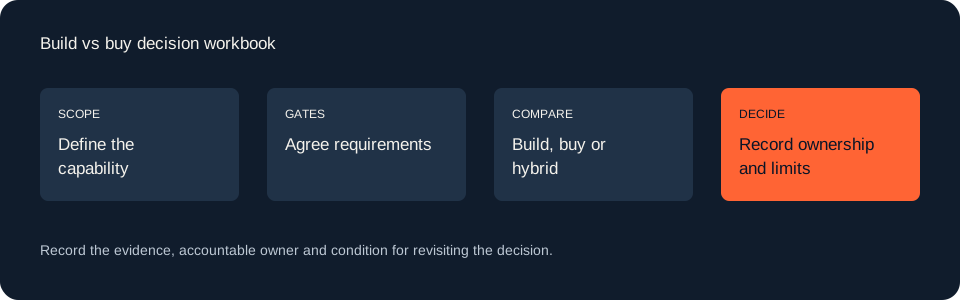
A decision about the entire platform can hide several different sourcing choices. An approval workflow, a customer-facing calculation and an identity integration may have different requirements and owners. Define the capability at the level where you can describe an accepted outcome and compare credible options without assuming the answer for neighboring systems.
The UK Government purchasing strategy guidance explicitly considers build, buy and a combined approach. Its government process is not a requirement for private companies, but the option comparison is a useful starting point for a practical review. Write down which existing product or internal component might satisfy the capability before commissioning something new.
Ask the sponsor why this capability matters to customers and which behavior needs direct control. Distinguish control of product decisions, access to source code, data ownership and the ability to operate or replace a component. These are separate requirements that a broad instruction to own the technology will not resolve.
This review concerns broader software sourcing and operating ownership. If your question is specifically about an AI model and a custom application layer, use the AI-specific build and buy discussion alongside the capability review. Keep its model decisions separate from the supplier, integration and exit obligations considered here.
Write must-have gates before comparing options
Define must-have requirements as observable gates with an owner and evidence requirement. An option that fails an essential gate needs a credible remediation path before it can proceed. Keep preferences and negotiable tradeoffs separate so a favorable price or polished demonstration cannot obscure a requirement the capability must meet.
Start with the customer outcome and operating conditions. Record required integrations, access behavior, data handling, availability expectations and any constraints confirmed by the appropriate owner. For legal or contractual requirements, obtain the responsible specialist's interpretation rather than assuming a worksheet establishes compliance. State what evidence will show that each gate is satisfied.
Microsoft architecture guidance recommends tools that meet workload requirements. Apply that principle by making the requirement specific enough to test. Integration support should identify the actual data and failure behavior required. An export requirement should describe the information, format and completeness the receiving system needs.
Assign a gate owner who can approve the evidence. Security, operations and product may each need to accept different parts of an option. A vendor assertion, an internal estimate and a tested result should be labeled separately. Unknown is a useful status when the decision depends on evidence that has not yet been collected.
For each gate, write the consequence of failure and whether a bounded trial can resolve it. Do not average a failed essential requirement into a total score. If a gate changes during the review, preserve the reason and have its owner confirm the revised condition before comparing options again.
Compare build, buy and hybrid on the same boundary
Describe a credible build, buy and hybrid option for the capability, using the same user outcome and gates. Include who delivers and who operates each option. Explain exclusions and unresolved assumptions so the comparison reflects feasible choices rather than an attractive product demo competing with an undefined internal project.
For build, identify the internal capability, delivery capacity and ongoing ownership required. External specialists can contribute to a build while the company retains agreed rights and product authority; sourcing people and sourcing a finished product are different choices. When comparing internal and external development teams, specify the retained responsibilities and handover evidence.
For buy, name a concrete product or service and the configuration needed for the scoped outcome. Record unsupported requirements, integration work and operating dependencies. For hybrid, state precisely which behavior remains custom and which component is acquired. The interface between them needs an owner and a change policy.
| Option | Define before estimating | Proof required |
|---|---|---|
| Build | Behavior, team, rights and operating owner | Delivery capacity and maintainable proof slice |
| Buy | Product, configuration and unsupported needs | Required workflow and actual data fit |
| Hybrid | Custom boundary and acquired component | Integration, responsibility and change behavior |
UK Government reuse guidance encourages avoiding duplication and unnecessary spending. Check existing technology and shared components during the comparison. Reuse still needs evidence of fit and ownership; an available component may require changes that alter both the estimate and the operating burden.
Estimate five lifecycle cost categories with actual assumptions
Compare lifecycle costs across delivery and acquisition, integration and migration, ongoing operation, change and security maintenance, and exit. Use the same planning horizon and demand assumptions for every option. Record quantities, rates, uncertainty and opportunity cost separately so the totals remain explainable when assumptions change.
Delivery and acquisition includes implementation effort, purchase or subscription terms and setup. Integration and migration includes adapters, data cleanup, reconciliation and transition work. Ongoing operation includes hosting, usage, monitoring, support and internal administration. Change and security maintenance includes upgrades, compatibility work and response responsibilities. Exit includes exporting data, replacing interfaces and operating through a transition.
The five categories are a workbook organization for this review, not a universal accounting standard. Finance and engineering should agree how to avoid double counting. If an internal employee's time appears in an implementation estimate, do not add the same hours again as an independent opportunity-cost charge without explaining the distinction.
Use actual quotes and observed workload where available, and label assumptions. Record the unit, source and range for uncertain values. A subscription estimate may change with demand; a build estimate may change with missing requirements. Compare scenarios that reflect your expected usage and a plausible change in that usage, with the assumptions visible.
For a broader discussion of custom software cost planning, carry the same boundary into the estimate. Ask the sponsor which other commitment loses capacity if the capability is built internally. State the displaced outcome and the person approving that tradeoff instead of presenting opportunity cost as an unsupported revenue forecast.
Inspect integration and prove a usable exit path
Test how the option works with actual systems, data and operating processes. Identify interface owners, failure handling and the steps needed to replace the component. Treat exportability as an end-to-end recovery and migration question, including permissions and completeness, rather than accepting a format name as proof of a workable exit.
UK Government integration guidance recommends technology that works with existing processes and infrastructure and can adapt to future demands. Translate that into a proof task using representative data. Test authentication, mapping, synchronization and the handling of rejected records. Include the person who will diagnose a failed integration after delivery.
UK Government open standards guidance links standards with interoperability. Open interfaces can help, but the actual implementation and contract still matter. Record API limits, version changes, data access conditions and dependencies on proprietary features. Confirm the information required to reconstruct the workflow elsewhere, including relevant metadata and relationships.
A clearly fictional example: a company evaluates an approval service for internal requests. The demo handles a standard approval, but the proof trial must also test reassignment, a failed synchronization and a complete export of request history. The hybrid option retains a custom policy layer while acquiring the workflow engine. Its usefulness depends on those boundaries working in practice.
For each option, describe who performs an exit, what they need and what stops working during the move. Ask for trial evidence where possible and mark unanswered questions. A plan that depends on undocumented supplier assistance needs a named investigation before it becomes an accepted assumption.
Assign security and operating responsibilities explicitly
Assign responsibilities for secure development, product security, updates, incidents and supplier changes for every option. Ask for evidence that matches the product and capability being acquired or built. Retain an internal owner for the customer outcome and escalation path even when implementation or operation is provided externally.
NIST SSDF provides a common language for secure development practices. Use that vocabulary to ask who performs relevant practices, what evidence is available and how findings become work. The framework does not turn completion of this workbook into certification or assurance that every security requirement is satisfied.
CISA Secure by Demand guidance encourages customers to ask explicitly about product security during procurement. Keep the product questions distinct from a supplier's general enterprise questionnaire. Ask about the product's update process, vulnerability handling and secure configuration relevant to your intended use, then identify who evaluates the answers.
NIST supply chain risk guidance addresses the reduced visibility an acquirer can have into how technology is developed, integrated and deployed. Record visibility limits and compensating review tasks for the actual supplier. An internal build also needs identifiable maintainers and dependencies; direct access to a repository does not resolve every operating risk.
When using a software supplier evaluation, include escalation contacts, knowledge transfer and ownership after delivery. Clarify who can authorize a disruptive update, who supports the integration and who verifies recovery. Leave unresolved responsibilities visible as decision gaps instead of assuming the service contract covers them.
Run a proof trial against the assumptions that matter
Choose a bounded proof trial that tests the assumptions most likely to change the sourcing decision. Use representative workflows and data, include failure and exit behavior, and define accepted evidence before starting. Keep trial effort and operating limits visible so a successful demonstration cannot imply full production readiness.
Select a slice that exercises an essential requirement, an integration and an operating responsibility. For a build option, a prototype should expose the difficult part of the capability rather than only presenting the interface. For buy, configure the actual workflow instead of accepting a sales demonstration of a neighboring use case. For hybrid, test the custom-to-acquired boundary.
Write the input, expected behavior, evaluator and evidence artifact for each trial task. Include the conditions that require stopping or revising the trial, such as unavailable data permission or an integration failure that exceeds the agreed boundary. Record any manual supplier intervention so it does not disappear from the operating model.
Return to the fictional approval-service example. The trial owner asks an operator to recover a failed synchronization and asks a separate reviewer to check the exported history. If either result depends on undocumented steps, the owner records the gap and its remediation cost before choosing an option.
Capture the version and configuration used, work excluded and support provided during the trial. Preserve the evidence with the gate record. If the trial cannot test a decisive assumption, choose a further investigation with a named owner rather than silently treating the assumption as satisfied.
Record the sourcing decision and its change triggers
Record Build, Buy, Hybrid or More evidence with the gates, lifecycle assumptions and proof results that support the choice. Name the accountable sponsor, operating owner and next action. Include the conditions that would reopen the decision, such as changed demand, an unsupported integration or an unacceptable supplier change.
State why the chosen option is feasible and why the alternatives were not selected under the current assumptions. Keep unresolved requirements and accepted tradeoffs explicit. If the answer is More evidence, identify the exact question and artifact required for another review. Assign the task to someone who can obtain the evidence.
The workbook compares three sourcing options, organizes five lifecycle cost categories and closes with one recorded sourcing decision. These counts describe a practical editorial review method. They do not create a validated procurement score or establish a universal speed advantage for any sourcing option.
If the next step involves custom software delivery, carry the capability boundary, gate owners and operating responsibilities into the brief. Define the proof required before a larger commitment, along with the internal capacity needed to review and integrate the result. The sourcing decision should remain connected to the workflow it was intended to support.
Store the final record with the estimates, trial evidence and responsibility map. Name who watches supplier changes, demand assumptions and exit conditions. When one of those conditions changes, revisit the affected capability and its options with the original evidence available to the next reviewer.
Build vs buy decision workbook
Compare build, buy and hybrid options using essential requirements, lifecycle costs, proof evidence and operating ownership.
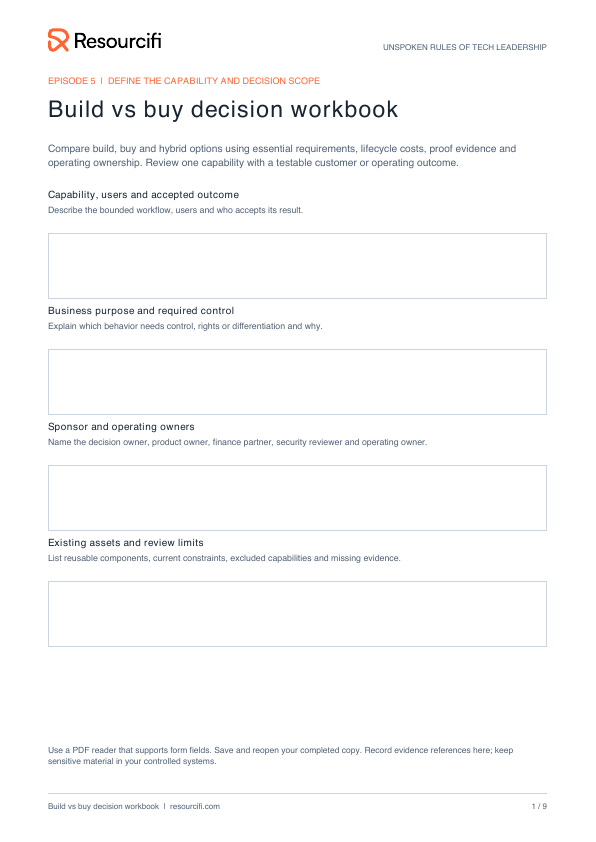
Fillable PDF · 9 pages · Save a copy for each review
Download the workbook
Enter your details for immediate access.
Your workbook is ready.
Open the fillable PDF and save a copy for your review. The delivery status above tells you whether your email was accepted for sending.
Download the workbookThis download link is valid for 7 days.
Build vs buy decision questions
What belongs in a build vs buy decision framework?
Should proprietary software always be built in-house?
Which lifecycle costs should we compare?
How do we evaluate a hybrid option?
What should a proof trial establish?
How do I download the sourcing workbook?
Sources
- UK Government, Define your purchasing strategy. Compare build, buy and combined options with full lifecycle cost and capability.
- UK Government, Make use of open standards. Open standards support interoperability and reduce dependence on proprietary interfaces.
- UK Government, Share, reuse and collaborate. Consider existing technology and shared components before duplicating work.
- UK Government, Integrate and adapt technology. Evaluate fit with existing technology and the ability to adapt to future needs.
- NIST, Secure Software Development Framework. A shared secure-development vocabulary supports producer and acquirer conversations.
- CISA, Secure by Demand Guide. Ask about product security when procuring software.
- Microsoft Learn, Architecture strategies for standardizing tools and processes. Evaluate mature tools against actual workload requirements and operating needs.
- NIST, Cybersecurity Supply Chain Risk Management Practices for Systems and Organizations. Assess supplier risk and limited visibility into how acquired technology is developed.