
LLM observability: what to monitor after release
LLM observability should let your team reconstruct a failed user task, identify the affected release and choose a useful response. Connect request traces to quality evidence, elapsed time, consumption and access decisions. Begin with a monitoring specification for one live workflow, then add instrumentation where an incident would otherwise leave an unanswered question.


The short version
- Start with the user task. A successful model call can still produce an unusable answer.
- Connect the evidence. Preserve request, release, source and tool context without collecting unnecessary content.
- Give alerts a response. Choose an owner and an available recovery action for each condition.
- Keep quality visible. Investigate corrections and missing answers alongside latency and consumption.
- Control telemetry access. Sampling and redaction affect what investigators can establish.
Monitor the complete task before choosing a dashboard
LLM observability needs a defined task boundary: what the user requested, what the application attempted and what happened afterward. Start there so successful network responses cannot conceal failed work. Keep operational status separate from task quality, and identify the evidence required to investigate each kind of failure.
Consider a fictional supplier-policy assistant. An employee asks whether a proposed purchase needs approval. The application retrieves policies the employee may access, drafts an explanation with source references and offers a link to the normal purchasing process. It cannot approve a purchase. This example defines the monitoring choices throughout the guide; its counts and response rules are editorial assumptions.
Record four task outcomes: answered, declined, escalated and failed. An answered task still needs quality assessment. An appropriate decline can be a correct outcome when the sources are insufficient. A failed task means the application could not complete the intended path. Establish these event meanings before comparing releases, or a new decline policy may look like a sudden reliability improvement.
NIST's Generative AI Profile discusses post-deployment monitoring, feedback, incident response and recovery. Adapt that operating perspective to your own feature. The bounded release checks establish readiness; this guide develops the evidence and ownership needed after users encounter real failures.
The proposed method has seven sections, four task outcomes and three operating roles: an incident lead, a product-quality owner and a telemetry custodian. One person can hold multiple roles in a small team, provided the responsibilities and backup arrangements are explicit.
Connect request traces to the evidence behind the answer
A useful trace connects the user request to retrieval, model calls and any downstream operation under a consistent request identity. Preserve release and configuration references so investigators can reproduce the relevant conditions. Decide which evidence belongs in protected supporting records instead of attaching every document and prompt to every span.
OpenTelemetry describes traces and spans as connected evidence of operations. For the policy assistant, a root task record should locate the retrieval attempt, model invocation and final response event. Include whether the user saw a result, because a completed backend request can coexist with a client disconnect. Record missing instrumentation explicitly instead of treating an incomplete trace as a short successful path.
The GenAI client inference conventions describe model and operation spans, including provider-reported token usage. Their status is Development. Check the implementation and version you actually use before adopting attribute names or promising cross-provider coverage. Keep your application-level task identity stable even if vendor instrumentation changes.
Store source identifiers and versions, the permission decision reference, prompt configuration and application release. When a policy changes, the investigator needs to know which policy supported the original answer. A reference to a mutable document without a version may be insufficient. Review whether investigators may access the underlying content before creating a replay route.
For a tool-using extension, agent and framework span conventions provide useful operation context, but instrumentation cannot establish that a tool was authorized. Capture the application's actual authorization result and the external outcome separately. A tool request marked complete may still require reconciliation with the receiving system.
Measure answer quality separately from service health
Task quality needs evidence about the usefulness and support of the result, beyond uptime or token counts. Define a reviewable quality question for each consequential output. Combine sampled assessments with user corrections and investigated incidents, while keeping the evaluation method and coverage visible when reporting trends.
For the policy assistant, ask whether the cited policy supports the answer, whether the employee had access and whether the reply preserved an important exception. A thumbs-up alone cannot establish those conditions. Make feedback categories specific enough to route: wrong policy, unsupported conclusion, missing exception or unavailable source. Let the user attach a request reference without requiring a copy of confidential purchasing details.
Keep a protected queue of disputed answers. The product-quality owner reviews the relevant source version, explains the decision and records whether the case requires a prompt change, source correction or product limitation. Add accepted regression cases to the release suite. The task evaluation guide explains how to define those grading criteria and preserve independent reference evidence.
When comparing periods, report how cases entered the review queue. A voluntary complaint queue and a random review sample represent different populations. An apparent decline in complaints might follow lower usage or a broken feedback button. Include the eligible task count and unavailable evidence before interpreting a change as better quality.
NIST's voluntary AI Risk Management Framework supports context-sensitive design, use and evaluation. It does not supply a universal acceptable-answer percentage for this assistant. Have the product owner approve criteria that reflect the consequences of a wrong purchase-policy answer and the availability of human escalation.
Choose signals that point to a concrete investigation
Select latency, consumption and dependency signals according to the decisions they support. Measure the elapsed user task as well as individual components, and preserve unsuccessful attempts. Each signal should identify the affected task population, comparison period, responsible owner and next investigative step when the condition changes.
OpenTelemetry's GenAI metrics documents distinguish client operation duration from server timing metrics. Neither automatically represents the employee's full waiting time. For the assistant, start elapsed task time at submission and stop when the visible answer, decline or failure reaches the client. Track retrieval delay and retries underneath that measurement so the team can identify where time went.
| Signal | Evidence | Owner and response |
|---|---|---|
| Task failure | Outcome and dependency error | Incident lead checks service and fallback |
| Unsupported answer | Reviewed answer and source version | Quality owner limits affected policy scope |
| Slow completion | Client elapsed time and component spans | Incident lead investigates the delayed dependency |
| Unexpected consumption | Calls, reported usage and retries | Incident lead inspects repeated work |
| Unexpected data capture | Protected telemetry inspection | Custodian restricts collection and access |
Token usage helps explain consumption but does not equal an invoice. Provider pricing categories, failed calls and non-model services need reconciliation. Keep price assumptions versioned when calculating estimated cost per task. Use the complete-task cost ledger when an increase requires a budget decision.
A low-volume feature may need a scheduled review before a statistical dashboard becomes useful. Choose thresholds from observed task behavior and the team's response capacity. Document the unresolved baseline when the product is new; avoid presenting an arbitrary alert threshold as an established service-level commitment.
Minimize captured content and make sampling limits visible
Collect the least sensitive evidence that can answer the investigation question, and decide who may inspect it. Apply retention and access rules to traces and exports as well as the main application. Document sampling choices because an absent trace may reflect collection policy rather than an absent failure.
OpenTelemetry's sensitive-data guidance discusses minimization, filtering and redaction. Inspect actual emitted attributes, logs and exceptions before enabling an integration broadly. A document reference can itself reveal a sensitive matter, while an error message can contain source text. Replacing a name with a predictable hash may leave it easy to identify.
For the assistant, keep routine telemetry to operational metadata and protected references. Use separately authorized content capture for a disputed answer when the review requires it. The custodian owns access requests, retention settings and deletion checks. Include downloaded traces, dashboard exports and support attachments in that procedure.
Head and tail sampling make collection decisions at different points. State which events your pipeline retains and what a missing trace means. If you retain failures preferentially, that trace collection is unsuitable as a direct estimate of the overall failure rate without a matching denominator and method.
OWASP's sensitive-information disclosure guidance supports limiting access to necessary data. Apply the same discipline to investigators: visibility into an incident does not automatically authorize reading every employee document. The application security controls provide the broader access context; the monitoring plan must identify how those decisions appear in operational evidence.
Attach a runbook and an available owner to each alert
An alert needs a named responder, sufficient evidence and an action the team can actually take. Define escalation and backup ownership before routing production notifications. Separate immediate containment from diagnosis and later quality improvement, with a record of what users can do while the feature is restricted.
For the fictional assistant, an increase in unavailable-source failures routes to the incident lead. The runbook first checks the retrieval dependency and affected policy set. If that set cannot be read reliably, the application declines those questions and directs employees to the normal policy process. The operator records the restriction and monitors whether unrelated questions remain usable.
A suspected permission failure requires a different response. Preserve protected evidence, stop the affected retrieval path and involve the appropriate security owner. Avoid copying the questionable content into a broad incident channel. The telemetry custodian can restrict evidence access while the product-quality owner examines whether previous outputs need investigation.
Test the runbook against a deliberately unavailable test dependency and an on-call handover. Confirm that the backup can find the dashboard, identify the release and activate the supported fallback. A named owner who lacks access to the relevant control cannot execute the response. Record that gap as operating work.
If the trace path, product controls and incident procedure need implementation together, discuss that concrete scope through AI integration. The useful inputs are the task boundary, sample failure, evidence restrictions and recovery action. A dashboard purchase alone does not assign the decisions the operating team still needs to make.
Use one failed task to test the monitoring specification
Test your specification by reconstructing a fictional incident from the evidence a responder would receive. Confirm that the record identifies the affected request, relevant source and configuration, user-visible outcome and available response. Revise collection or ownership when the investigator encounters an unanswered question, then repeat the exercise after a material change.
In the policy example, an employee reports an answer that omitted a purchasing exception. The request reference locates the task outcome and release. Retrieval records identify the policy version. The quality owner compares the cited passage with the full relevant exception and records an unsupported conclusion. The model call succeeded technically, so an error-rate alert alone would have missed this case.
The incident lead checks whether the affected source or prompt configuration is shared across other policy questions. The product owner restricts the disputed category until the answer behavior has been corrected and evaluated. The custodian verifies that the evidence remains available to authorized reviewers without broadening routine content collection.
Close the incident with the correction, regression case, exposure limits and next monitoring check. A new prompt is a change to investigate, not evidence that every related answer is fixed. Review the affected task population using the declared method, and preserve unresolved cases rather than turning their absence from a dashboard into a favorable result.
Before expanding monitoring, remove fields nobody uses and alerts nobody can act on. Revisit the specification when sources, permissions, providers, task volume or downstream authority change. The operating deliverable is a maintained agreement between evidence and response, with enough detail for a responder who did not build the feature to handle a real failure.
AI production monitoring and ownership workbook
Use the workbook to define your project scope, record evidence and agree the next action.
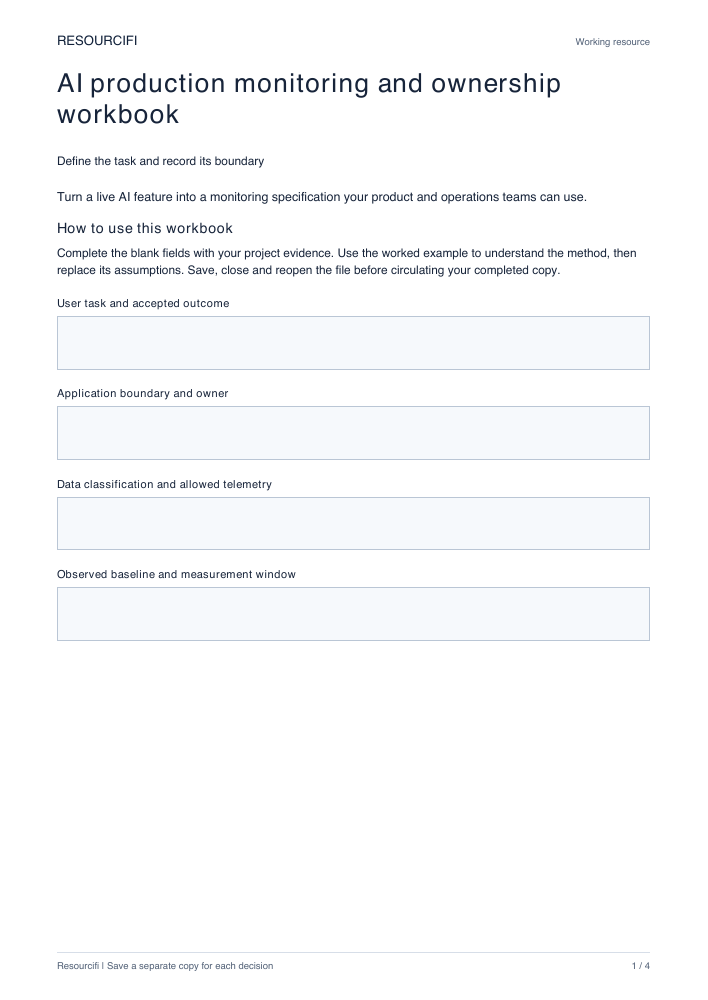
Fillable PDF | 4 pages | Save a copy for your review
Download the workbook
Use the form to access the companion workbook.
Your workbook is ready.
Open the fillable PDF and save a copy for your review. The delivery status above tells you whether your email was accepted for sending.
Download the workbookThis download link is valid for 7 days.
Frequently asked questions
What should LLM observability measure first?
Start with the complete user task, its outcome and the evidence needed to explain a failure. Connect that record to model calls, retrieval and any downstream operation. Add elapsed time and consumption without treating them as quality scores. A small feature can begin with a reviewable task ledger and a practical response procedure before it needs a large dashboard.
Does a successful trace prove that an answer is correct?
A trace records instrumented operations and their context. It can show that retrieval and a model call completed while the answer still omitted an exception or used irrelevant evidence. Assess consequential claims against the relevant source and task criteria. Keep the resulting quality decision connected to the trace, with the reviewer method and any missing evidence made explicit.
Should prompts and responses always be logged?
Choose capture according to the investigation need and the sensitivity of the material. Operational metadata and protected source references may be enough for routine monitoring. A disputed answer may need separately authorized content capture. Inspect exceptions, exports and integration defaults as well as visible trace fields. Define access and retention, then test that the implemented controls match the plan.
How should a team set alert thresholds?
Begin with the user consequence, observed baseline and action available to the responder. Define the affected population and comparison period before selecting a threshold. Keep new-product assumptions clearly labelled until operating evidence supports a stronger commitment. Review alerts that repeatedly require no action, and investigate silence when complaints or manual checks suggest the signal is missing relevant failures.
Can sampled traces support incident investigation?
Sampled traces can help when the relevant request was retained and the needed fields are available. Document the collection method so investigators understand what a missing trace means. Preserve suitable outcome counters separately when they are needed for population-level rates. Preferentially retained failures describe that retained set; they do not automatically describe every user task or establish the overall failure rate.
Sources
- OpenTelemetry, Semantic conventions for generative AI client inference. Development-status GenAI client inference spans and provider-reported input token usage.
- OpenTelemetry, Semantic conventions for generative AI metrics. Development-status GenAI client duration and server timing metrics, with differing measurement boundaries.
- OpenTelemetry, Semantic Conventions for GenAI agent and framework spans. Development-status agent and framework operation context; coverage depends on instrumentation.
- OpenTelemetry, Handling sensitive data | OpenTelemetry. Telemetry data minimization, filtering, redaction and sensitive-information handling.
- OpenTelemetry, Traces | OpenTelemetry. Connected spans as operational evidence within a trace.
- OpenTelemetry, Sampling | OpenTelemetry. Head and tail sampling choices and their effect on retained telemetry.
- NIST, AI Risk Management Framework | NIST. Voluntary guidance for context-sensitive AI design, use and evaluation.
- NIST, Artificial Intelligence Risk Management Framework: Generative Artificial Intelligence Profile. Generative AI governance, testing, post-deployment monitoring, feedback and incident response.
- OWASP Gen AI Security Project, OWASP LLM02: 2025 Sensitive Information Disclosure. Sensitive-information disclosure risk and limiting access to necessary data.